


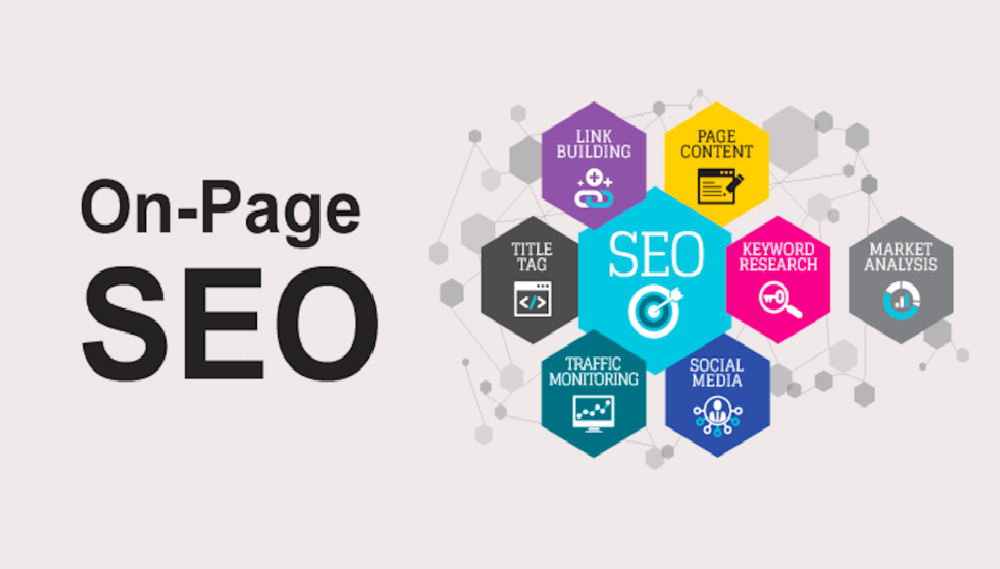
On-page SEO is the practice of optimising everything that exists on a web page itself — the title tag, H-tag hierarchy, body content, internal links, URL structure, schema markup, image alt text, and page speed — so that Google can correctly understand, index, and rank it. Off-page authority matters, but a page with poor on-page signals will not hold a top-3 position even with a strong backlink profile. Garuda Technologies delivers systematic on-page SEO optimisation for IT companies, SaaS products, ecommerce stores, and B2B service providers in Gurgaon, producing ranking improvements on target pages within 4 to 8 weeks of implementation.
Most Gurgaon businesses fix their title tags, call it 'on-page SEO', and move on. Title tags are one of approximately 12 distinct on-page signals Google evaluates. Pages ranking at position 1 for competitive queries almost always score well across all 12 — not just one or two. The full signal set is documented below.
On-Page Signal | What It Does and Why It Matters | Priority |
Title Tag | Primary on-page ranking signal. Must include the target keyword within the first 60 characters, match search intent precisely, and differentiate from competitor titles in the same SERP. Generic titles like 'Home' or 'Services' actively suppress rankings. | P1 — Fix immediately |
Meta Description | Not a direct ranking factor, but controls click-through rate. A meta description that matches search intent and includes a clear value proposition improves CTR by 5 to 15 percent, which Google's RankBrain interprets as a positive engagement signal. | P1 — Fix immediately |
H1 Tag | One H1 per page, containing the primary keyword. The H1 confirms the page topic to Googlebot. Multiple H1 tags create topic ambiguity; absent H1 tags force Google to infer the topic from other signals with lower accuracy. | P1 — Fix immediately |
H2 and H3 Structure | Subheadings create a content hierarchy that helps Googlebot understand page structure and identify key subtopics. H2s targeting secondary keywords expand the page's topical coverage and improve AI Overview extraction probability. | P1 — Fix immediately |
URL Structure | Clean, keyword-containing, hyphen-separated URLs. /on-page-seo-services-gurgaon/ outperforms /page?id=47&cat=3. URL length under 75 characters. No stop words where avoidable. | P2 |
Body Content — Keyword Placement | Primary keyword in the first 100 words of body content. Secondary keywords and LSI terms distributed naturally throughout. No keyword stuffing — aim for 1 to 2 percent keyword density for the primary term. | P1 — Fix immediately |
Content Depth and Topical Coverage | Pages ranking at position 1 cover a topic more completely than competitors. Thin content — under 500 words on a service page — signals low value to Google. Service pages need 800 to 1,500 words with specific, data-supported claims. | P2 |
Internal Linking | Contextual internal links from related pages to target pages distribute authority and establish topic relevance. A service page with zero internal links pointing to it is an orphan page — Google assigns it minimal authority regardless of content quality. | P2 |
Image Optimisation | Descriptive file names (on-page-seo-services-gurgaon.webp, not IMG_4421.jpg), alt text containing the target keyword, WebP format for compression, and explicit width/height attributes to prevent CLS failures. | P2 |
Schema Markup | JSON-LD schema — Service, FAQPage, BreadcrumbList — makes page content machine-readable for rich results and AI Overview citations. Pages with FAQPage schema are significantly more likely to appear in featured snippets. | P2 |
Page Speed (LCP) | Largest Contentful Paint under 2.5 seconds on mobile. Slow pages lose rankings to faster equivalents. LCP failures are the most common on-page performance issue found in Gurgaon IT company audits. | P1 — Fix immediately |
E-E-A-T Signals | Author attribution, publication date, external source citations, and company information signals. Critical for YMYL pages (healthcare, finance, legal) and increasingly important for all B2B content. | P2 |
Every target page is crawled to extract current title tags, meta descriptions, H-tag usage, word count, internal link count and anchor text, image alt text, URL structure, and schema presence. The output is a per-page signal matrix showing the current state against best-practice benchmarks for each of the 12 on-page signals. Pages are scored and prioritised by revenue potential — service pages and category pages receive attention before blog posts.
A title tag optimised for the wrong search intent is worse than no optimisation at all. A user searching 'on-page SEO' wants an explanation or a service — not a product purchase page. We verify that each page's content type, format, and depth match the dominant intent behind its target keyword. Intent misalignment is one of the most common reasons well-optimised pages fail to rank — and one of the least-diagnosed problems in Gurgaon SEO audits.
The top 3 ranking pages for each target keyword are analysed for word count, H-tag structure, schema usage, content depth, and internal link profile. The gap between your page and the top-ranking page is measured across each signal. Optimisation work closes those specific gaps — not generic 'best practice' recommendations that may not reflect what is actually needed to rank for your specific keyword in your specific SERP.
Recommendations are delivered as a prioritised implementation brief with exact replacement copy for title tags and meta descriptions, revised H-tag structure, internal link additions with anchor text, schema markup code, and image alt text updates. After implementation, pages are re-crawled and submitted to Google Search Console for re-indexing. Search Console impressions typically begin improving within 2 to 4 weeks of correct on-page optimisation.
After auditing more than 50 IT company websites in Gurgaon and Delhi NCR, these six on-page failures appear more frequently than any others and account for the majority of ranking underperformance on service pages.
Failure | Detail and Fix |
Title tag written for the company, not the searcher | Example: 'Garuda Technologies — IT Solutions' instead of 'IT Services Company Gurgaon | Garuda Technologies'. The searcher types a query, not a company name. Title tags must lead with the keyword the searcher used. |
H1 and title tag are identical | The title tag and H1 can include the same keyword but should not be word-for-word identical. The H1 is an opportunity to add a secondary keyword or value statement that broadens the page's topical coverage. |
Service pages under 400 words | Short service pages signal thin content to Google. A 300-word 'SEO Services' page cannot compete against a 1,200-word page that covers the process, outcomes, and FAQs in detail. Depth is a ranking advantage. |
Zero internal links pointing to key service pages | The homepage links to a services overview. The services overview links to individual service pages. Nothing else links to those individual pages. Authority accumulates at the top of the funnel and never reaches the pages that need it most. |
Images with file names like IMG_001.jpg | Image file names contribute to page relevance signals. An image named 'seo-services-gurgaon-audit.webp' is more useful than 'screenshot-2024-01-15.png'. Alt text is frequently blank or generic across IT company websites. |
No schema markup on any page | Under 20 percent of Gurgaon IT company websites have any schema markup. Service schema, FAQPage schema, and BreadcrumbList schema are 30-minute implementations that improve rich result eligibility and AI Overview citation probability. |
Discipline | What It Does and When to Use It |
On-Page SEO | Optimises the technical and structural signals on existing pages: title tags, H-tags, URLs, internal links, schema, image alt text, and page speed. The content already exists — on-page SEO makes it legible and rankable for search engines. |
Content SEO | Creates new content based on keyword gap analysis and topical authority mapping. Involves writing new pages, blog posts, and cluster content that do not yet exist on the site. |
When to prioritise on-page SEO | When existing pages are ranking on page 2 or 3 (positions 11–30) and on-page signals are the gap between current position and top 3. When a site migration has disrupted title tags, H-tags, or URLs. When new pages are being published and need correct on-page foundations. |
When to prioritise content SEO | When target keywords have no corresponding page on the site. When competitor gap analysis reveals entire topic clusters that your site does not cover. When topical authority is shallow across the domain. |
Metric | What to Expect and When |
Google Search Console impressions | First metric to move after on-page changes. Improved title tags and H-tags make pages eligible to appear for a broader range of related queries. Impressions typically increase within 2 to 4 weeks of implementation. |
Click-through rate (CTR) | Improved meta descriptions and title tags that match search intent more precisely produce higher CTR. A CTR improvement from 2.1 percent to 3.4 percent on 10,000 impressions adds 130 additional organic sessions monthly — from the same ranking position. |
Average keyword position | Target keywords should move up in average position as on-page signals align with what top-ranking pages demonstrate. Position movement of 3 to 7 places on near-page-1 keywords is a standard 60-day outcome for well-executed on-page work. |
Rich result appearances | Schema markup implementation produces featured snippets and FAQ rich results. Monitor in Google Search Console under Enhancements for FAQs and rich results eligibility. |
Organic sessions from target pages | The ultimate on-page SEO metric. Higher positions + better CTR = more organic sessions. Report on sessions from specific target service pages, not overall domain traffic. |
Google typically re-crawls and re-indexes pages within 3 to 14 days of changes being made, depending on crawl frequency for your domain. Search Console impressions show the first signal of improvement within 2 to 4 weeks. Position movement on target keywords becomes visible between weeks 4 and 8. Full ranking impact, including compounding effects from improved CTR feeding positive engagement signals, is measurable at the 60 to 90-day mark.
One primary keyword per page, supported by 3 to 5 semantically related secondary keywords. Targeting multiple primary keywords on a single page creates topic dilution — Google cannot determine which query the page is most relevant for. Secondary keywords support the primary topic without competing with it. For example, a page targeting 'on-page SEO services Gurgaon' can naturally incorporate 'on-page SEO company India', 'title tag optimisation', and 'meta description SEO' without creating keyword conflict.
Yes, and its importance has increased for AI search specifically. Google AI Overviews extract direct answers from pages with structured headings, clear answer-first paragraphs, and FAQPage schema — all on-page SEO elements. ChatGPT and Perplexity's web search modes rank pages using the same signals as traditional SEO before extracting citation-worthy passages. On-page structure determines whether your content is extractable by AI systems. Poor on-page structure makes your content invisible to both Google's crawler and AI response generators.
On-page SEO covers the visible content signals on a page: title tags, headings, body copy, internal links, and schema markup. Technical SEO covers the infrastructure beneath the content: crawlability, indexation, page speed, JavaScript rendering, site architecture, and server configuration. Both are required for top rankings. Technical SEO ensures Google can access the page. On-page SEO ensures Google can understand and rank it correctly. The two disciplines are audited separately but fixed in the same implementation cycle.

Garuda Technologies - Copyright . All rights reserved.
Garuda Technologies is a Gurgaon-headquartered technology and travel services company operating from Udyog Vihar, Sector 19 — the heart of Gurugram's IT and industrial corridor. Founded with the conviction that businesses deserve a single accountable partner for their digital and travel needs, Garuda Technologies operates two integrated verticals: a full-spectrum IT and digital services division, and a travel services division powered by seven specialized travel brands.